





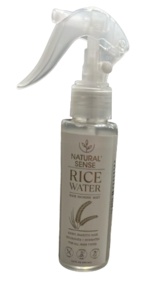
Rice Water

Highlights
Skim through
| Ingredient name | what-it-does | irr., com. | ID-Rating |
|---|---|---|---|
| Water (Eau) | solvent | ||
| Oryza Sativa (Rice) Bran Water Extract | |||
| Propanediol | solvent, moisturizer/humectant | ||
| Propylene Glycol | moisturizer/humectant, solvent | 0, 0 | |
| Glycerin | skin-identical ingredient, moisturizer/humectant | 0, 0 | superstar |
| Phenoxyethanol | preservative | ||
| Ethylhexylglycerin | preservative | ||
| Polyquaternium-73 | |||
| Panthenol | soothing, moisturizer/humectant | 0, 0 | goodie |
| Sodium Benzoate | preservative | ||
| Sodium Gluconate | chelating, moisturizer/humectant |
Natural Sense Rice WaterIngredients explained
Good old water, aka H2O. The most common skincare ingredient of all. You can usually find it right in the very first spot of the ingredient list, meaning it’s the biggest thing out of all the stuff that makes up the product.
It’s mainly a solvent for ingredients that do not like to dissolve in oils but rather in water.
Once inside the skin, it hydrates, but not from the outside - putting pure water on the skin (hello long baths!) is drying.
One more thing: the water used in cosmetics is purified and deionized (it means that almost all of the mineral ions inside it is removed). Like this, the products can stay more stable over time.
This ingredient name is not according to the INCI-standard. :( What, why?!
Propanediol is a natural alternative for the often used and often bad-mouthed propylene glycol. It's produced sustainably from corn sugar and it's Ecocert approved.
It's quite a multi-tasker: can be used to improve skin moisturization, as a solvent, to boost preservative efficacy or to influence the sensory properties of the end formula.
- It's a helper ingredient that improves the freeze-thaw stability of products
- It's also a solvent, humectant and to some extent a penetration enhancer
- It has a bad reputation among natural cosmetics advocates but cosmetic scientists and toxicology experts do not agree (read more in the geeky details section)
- A natural moisturizer that’s also in our skin
- A super common, safe, effective and cheap molecule used for more than 50 years
- Not only a simple moisturizer but knows much more: keeps the skin lipids between our skin cells in a healthy (liquid crystal) state, protects against irritation, helps to restore barrier
- Effective from as low as 3% with even more benefits for dry skin at higher concentrations up to 20-40%
- High-glycerin moisturizers are awesome for treating severely dry skin
It’s pretty much the current IT-preservative. It’s safe and gentle, but even more importantly, it’s not a feared-by-everyone-mostly-without-scientific-reason paraben.
It’s not something new: it was introduced around 1950 and today it can be used up to 1% worldwide. It can be found in nature - in green tea - but the version used in cosmetics is synthetic.
Other than having a good safety profile and being quite gentle to the skin it has some other advantages too. It can be used in many types of formulations as it has great thermal stability (can be heated up to 85°C) and works on a wide range of pH levels (ph 3-10).
It’s often used together with ethylhexylglycerin as it nicely improves the preservative activity of phenoxyethanol.
If you have spotted ethylhexylglycerin on the ingredient list, most probably you will see there also the current IT-preservative, phenoxyethanol. They are good friends because ethylhexylglycerin can boost the effectiveness of phenoxyethanol (and other preservatives) and as an added bonus it feels nice on the skin too.
Also, it's an effective deodorant and a medium spreading emollient.
 We don't have description for this ingredient yet.
An easy-to-formulate, commonly used, nice to have ingredient that’s also called pro-vitamin B5. As you might guess from the “pro” part, it’s a precursor to vitamin B5 (whose fancy name is pantothenic acid).
Its main job in skincare products is to moisturise the skin. It’s a humectant meaning that it can help the skin to attract water and then hold onto it. There is also research showing that panthenol can help our skin to produce more lovely lipids that are important for a strong and healthy skin barrier.
Another great thing about panthenol is that it has anti-inflammatory and skin protecting abilities. A study shows that it can reduce the irritation caused by less-nice other ingredients (e.g. fragrance, preservatives or chemical sunscreens) in the product.
Research also shows that it might be useful for wound healing as it promotes fibroblast (nice type of cells in our skin that produce skin-firming collagen) proliferation.
If that wasn’t enough panthenol is also useful in nail and hair care products. A study shows that a nail treatment liquide with 2% panthenol could effectively get into the nail and significantly increase the hydration of it.
As for the hair the hydration effect is also true there. Panthenol might make your hair softer, more elastic and helps to comb your hair more easily.
A helper ingredient that helps to make the products stay nice longer, aka preservative. It works mainly against fungi.
It’s pH dependent and works best at acidic pH levels (3-5). It’s not strong enough to be used in itself so it’s always combined with something else, often with potassium sorbate.
The neutralized form of gluconic acid. It's a great ingredient to neutralize metal (especially iron and copper) ions in a cosmetic product. This helps to prevent discoloration of the formula over time or rancidity of cosmetic oils. It can also be a pH regulator and a humectant (helps skin to cling onto water).
It's also used in oral care products where it reduces the bitterness of other ingredients. And it's natural, both Ecocert and Cosmos approved. (source: manufacturer info)
You may also want to take a look at...
| what‑it‑does | solvent |
| what‑it‑does | solvent | moisturizer/humectant |
| what‑it‑does | moisturizer/humectant | solvent |
| irritancy, com. | 0, 0 |
| what‑it‑does | skin-identical ingredient | moisturizer/humectant |
| irritancy, com. | 0, 0 |
| what‑it‑does | preservative |
| what‑it‑does | preservative |
| what‑it‑does | soothing | moisturizer/humectant |
| irritancy, com. | 0, 0 |
| what‑it‑does | preservative |
| what‑it‑does | chelating | moisturizer/humectant |