





Highlights
Other Ingredients
Skim through
| Ingredient name | what-it-does | irr., com. | ID-Rating |
|---|---|---|---|
| Water | solvent | ||
| Sorbitol | moisturizer/humectant | 0, 0 | |
| Hydrated Silica | abrasive/scrub, viscosity controlling | ||
| Sodium Lauryl Sulfate | surfactant/cleansing, emulsifying | com.:0 | icky |
| Propylene Glycol | moisturizer/humectant, solvent | 0, 0 | |
| Cellulose Gum | viscosity controlling | 0, 0 | |
| Menthol | soothing | icky | |
| Flavor | |||
| Sodium Benzoate | preservative | ||
| Sodium Saccharin | |||
| Sodium Fluoride | |||
| Hydroxypropyl Guar | surfactant/cleansing, viscosity controlling | ||
| Xylitol | moisturizer/humectant | goodie | |
| Cocamidopropyl Betaine | surfactant/cleansing | ||
| Methyl Diisopropyl Propionamide | |||
| Ci 77891 | colorant | 0, 0 |
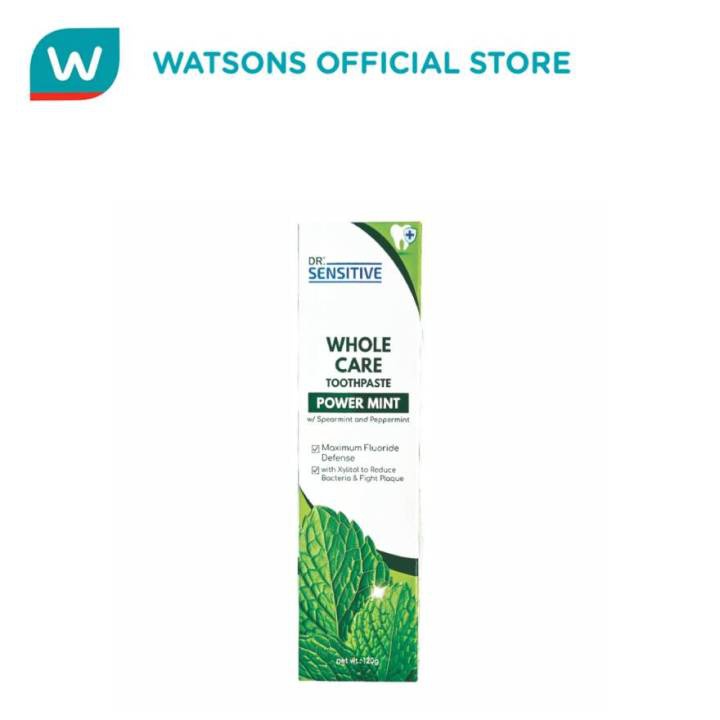
Dr. Sensitive Whole Care Toothpaste Power MintIngredients explained
Good old water, aka H2O. The most common skincare ingredient of all. You can usually find it right in the very first spot of the ingredient list, meaning it’s the biggest thing out of all the stuff that makes up the product.
It’s mainly a solvent for ingredients that do not like to dissolve in oils but rather in water.
Once inside the skin, it hydrates, but not from the outside - putting pure water on the skin (hello long baths!) is drying.
One more thing: the water used in cosmetics is purified and deionized (it means that almost all of the mineral ions inside it is removed). Like this, the products can stay more stable over time.
It's a sweet tasting sugar substitute that helps your skin to hold onto water when used in cosmetic products. It also helps to thicken up products and give them a bit more slip.
 We don't have description for this ingredient yet.
The famous or rather infamous SLS (not to be confused with SLES). It is a cleansing agent known for being too good at the job and potentially irritating the skin. But, on the positive side, it can produce copious, creamy and luxurious foam compared to the more gentle and thus nowadays much more commonly used Sodium Laureth Sulfate.
In fact, SLS is so good at irritating the skin that it is very commonly used in dermatological studies just for that. It is a so-called "primary irritant", a substance that irritates the skin in one go (without prior sensitization) but doesn't do any other big harm (such as being carcinogenic or systematically toxic - those claims are not true). Also, the formula can greatly influence the irritating potential of SLS, and mixing it with other cleaning agents makes it milder.
If it's not in a cleanser, it works as an emulsifier or even as a penetration enhancer for active materials.
- It's a helper ingredient that improves the freeze-thaw stability of products
- It's also a solvent, humectant and to some extent a penetration enhancer
- It has a bad reputation among natural cosmetics advocates but cosmetic scientists and toxicology experts do not agree (read more in the geeky details section)
A cellulose (the big molecule found in the cell wall of green plants) derivative that is used as an emulsion stabilizer and thickener.
Menthol needs no introduction: it's the thing that causes the cooling sensation so well-known both from cosmetic products as well as a bunch of other things like chocolate, chewing gum, toothpaste or cigarette. It's a natural compound that comes from the essential oil of Mentha species (peppermint oil contains 40-50% menthol) and it gives them their typical minty smell and flavor.
As for skincare, menthol seems to be a mixed bag. Apart from the cool cooling sensation (that might last up to 70 mins!), it also has painkilling, itch reducing, antibacterial, antifungal and even penetration enhancing properties. On the other hand, it also seems to act as a skin irritant that increases trans-epidermal water loss (the water that evaporates from the outer layer of the skin) and thus contributes to drying out the skin.
We don't have description for this ingredient yet.
A helper ingredient that helps to make the products stay nice longer, aka preservative. It works mainly against fungi.
It’s pH dependent and works best at acidic pH levels (3-5). It’s not strong enough to be used in itself so it’s always combined with something else, often with potassium sorbate.
We don't have description for this ingredient yet.
We don't have description for this ingredient yet.
We don't have description for this ingredient yet.
A type of sugar that's part of a moisturizing trio called Aquaxyl. You can read more about its magic properties at xylitylglucoside.
Super common ingredient in all kinds of cleansing products: face and body washes, shampoos and foam baths.
Number one reason for its popularity has to do with bubbles. Everyone loves bubbles. And cocamidopropyl betaine is great at stabilizing them.
The other reason is that it’s mild and works very well combined with other cleansing agents and surfactants. The art of cleansing is usually to balance between properly cleansing but not over-cleansing and cocamidopropyl betaine is helpful in pulling off this balance right.
Oh, and one more nice thing: even though it’s synthetic it’s highly biodegradable.
More info on CAPB on Collins Beaty Pages.
A molecule that gives a long-lasting cooling and chilling effect to the formula. It is not derived from menthol and, according to the manufacturer, is not allergenic.
Ci 77891 is the color code of titanium dioxide. It's a white pigment with great color consistency and dispersibility.
You may also want to take a look at...
| what‑it‑does | solvent |
| what‑it‑does | moisturizer/humectant |
| irritancy, com. | 0, 0 |
| what‑it‑does | abrasive/scrub | viscosity controlling |
| what‑it‑does | surfactant/cleansing | emulsifying |
| com. | 0 |
| what‑it‑does | moisturizer/humectant | solvent |
| irritancy, com. | 0, 0 |
| what‑it‑does | viscosity controlling |
| irritancy, com. | 0, 0 |
| what‑it‑does | soothing |
| what‑it‑does | preservative |
| what‑it‑does | surfactant/cleansing | viscosity controlling |
| what‑it‑does | moisturizer/humectant |
| what‑it‑does | surfactant/cleansing |
| what‑it‑does | colorant |
| irritancy, com. | 0, 0 |